Kilimanjaro speed records
The fastest times on Africa’s highest mountain: from the park-gate sprints of Karl Egloff and Kílian Jornet to the first ascent and descent of the whole mountain, from its true base, in a single day.
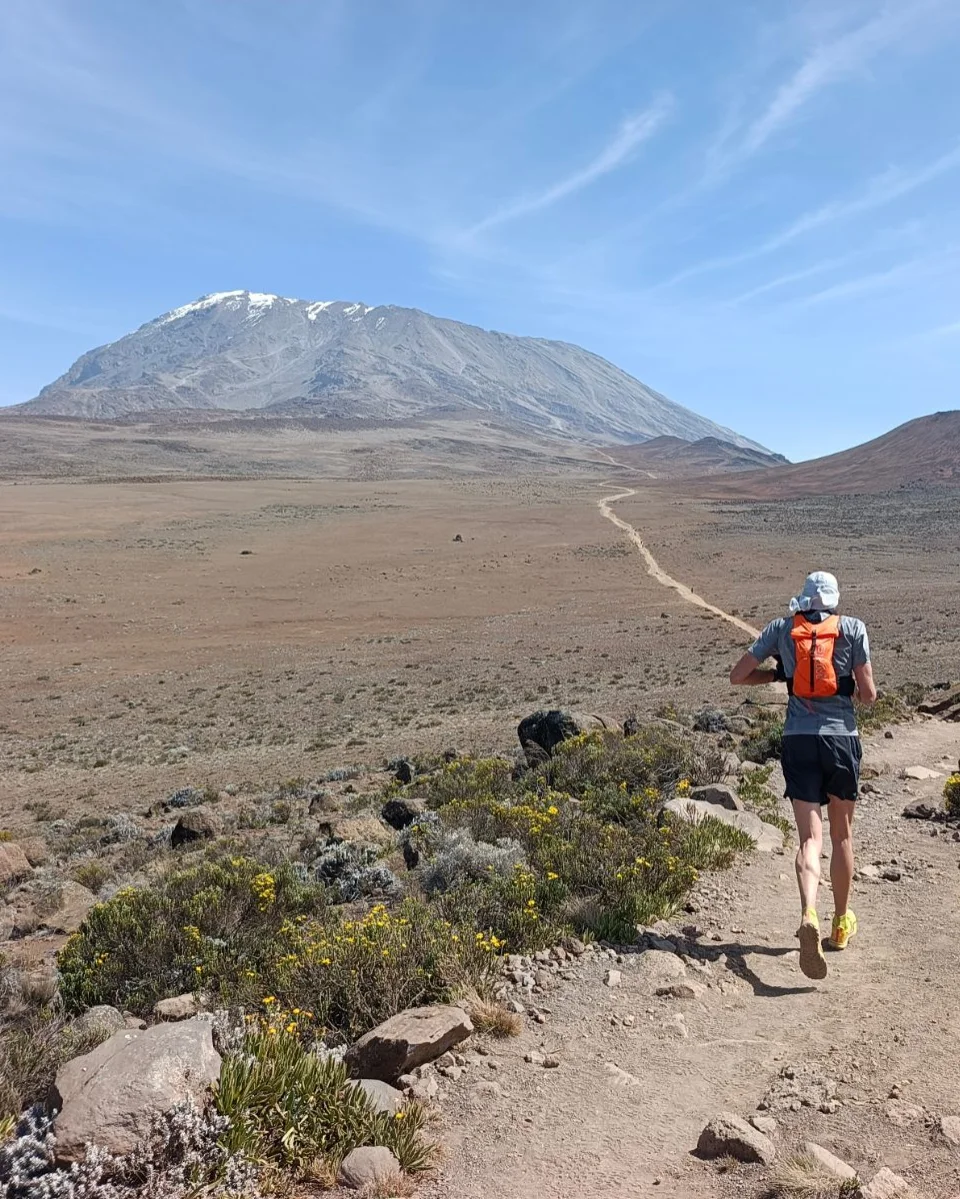
Kilimanjaro is the tallest freestanding mountain on earth, and every one of its 5,118 vertical metres can be climbed without ropes, on a bicycle and on foot. That makes it one of the great proving grounds for human endurance. Here are the people who have set the marks so far, the people elsewhere who showed what is possible, and how you can make an attempt of your own.
- 23:58:01The complete mountain, 777 m to the summit and back
- 6:42:24Fastest up and down from a park gate
- 10:06Fastest woman, up and down
- 9:21:47Fastest unsupported
5,118 mFrom the mountain’s base at 777 m to Uhuru Peak, 5,895 m
The records
Times are for ascent and descent unless stated. Every record but one starts at a park gate, at the edge of the forest; the first row starts at the bottom of the mountain itself.
| Record | Who | Started from | Time | Date |
|---|
| The complete mountainTrue base | John Rees-EvansMabungo, 777 m, to Uhuru Peak and back. Bicycle and on foot, Marangu route up, service road and Maua Gate down. 117 km. | 777 m base | 23:58:01 | 7 July 2026 |
| Fastest ascent and descent | Karl Egloff · Switzerland/EcuadorUp from Umbwe Gate via the Western Breach in 4 h 56 min; down to Mweka Gate. | Umbwe Gate, 1,640 m | 6:42:24 | 13 August 2014 |
| Previous record | Kílian Jornet · SpainUp in 5 h 23 min, by the same Umbwe line Egloff later bettered. | Umbwe Gate, 1,640 m | 7:14 | 2010 |
| Fastest woman, ascent and descent | Fernanda Maciel · BrazilUmbwe Gate to the summit, down to Mweka Gate. Beat Anne-Marie Flammersfeld’s 12 h 58 min. | Umbwe Gate, 1,640 m | 10:06 | 2017 |
| Fastest woman, ascent | Kristina Schou Madsen · DenmarkReported ascent time; 13 h 30 min 39 s up and down. | Mweka route | 6:52:54 | 2018 |
| Unsupported ascent and descent | Simon Mtuy · TanzaniaCarried everything he needed, with no support or resupply, up and down from Umbwe Gate. Verified by Team Kilimanjaro. | Umbwe Gate, 1,640 m | 9:21:47 | 22 February 2006 |
Park-gate figures as reported by the athletes and in the press; see the sources at the foot of the page. Know of a time we have missed? Tell us and we will add it.
Where the mountain begins
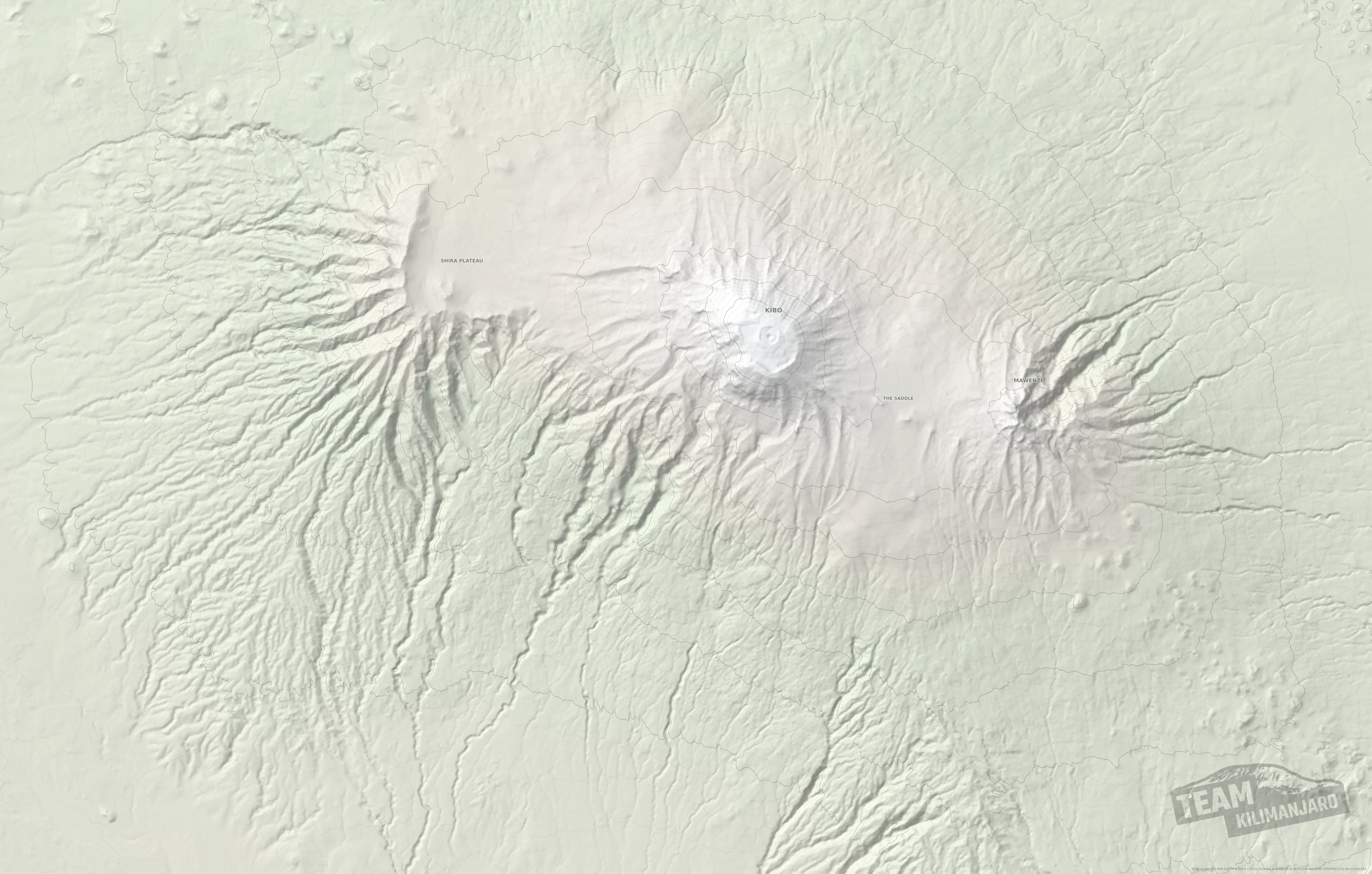
Every park-gate record, however remarkable, starts at a fence. The park boundary runs where the farms end and the forest begins, a line drawn for land ownership rather than for geology. Below it, the coffee, banana and maize country is still the mountain: it drains from Kilimanjaro, it is built from Kilimanjaro, and it rises unbroken from the road that circles the massif.
The lowest point on that perimeter road is 777 m, at Mabungo. From there to Uhuru Peak is 5,118 m of ascent, more than a thousand metres more than any park gate offers.
- Marangu Gate1,858 m4,037 m to the summit
- Machame Gate1,800 m4,095 m to the summit
- Umbwe Gate1,640 m4,255 m to the summit
- Mabungo, the true base777 m5,118 m to the summit
“Political circumstances shouldn’t define a mountain. Kilimanjaro extends to its perimeter road, and a genuine ascent must begin there.”
John Rees-Evans, founder of Team Kilimanjaro
The complete mountain, in a day
On 7 July 2026, at the age of 48, our founder John Rees-Evans left Mabungo at midnight, reached Uhuru Peak at 17:54 and was back at the same point 23 hours, 58 minutes and 1 second after he set off: the first recorded ascent and descent of Kilimanjaro from its true base. 117 km, by bicycle and on foot.
- Bicycle777 m → Marangu Village17.25 km · +659 m
- RunMarangu Village → Marangu Gate5.17 km · +482 m
- RunMarangu Gate → Mandara Hut7.95 km · +872 m
- RunMandara Hut → Horombo Hut11.78 km · +1,086 m
- HikeHorombo Hut → Kibo Hut9.41 km · +1,034 m
- HikeKibo Hut → Gilman’s → Uhuru Peak4.90 km · +1,206 m · summit 17:54
- RunUhuru Peak → Kibo Hut~4.9 km · −1,195 m
- BicycleKibo Hut → Maua Gate → 777 m~54 km · −3,923 m · finish 23:58:01
Five guides took turns alongside him, with cooks waiting at Mandara, Horombo and Kibo and a second bicycle at Kibo Hut for the descent. Ten days later, on 17 July, he rode once round the mountain’s perimeter, 232.06 km, in 15 hours, 50 minutes and 4 seconds: the horizontal measure to match the vertical one.
The full record, with the map, profile and splits · Watch the ascent · Watch the circumnavigation
Sea to summit: the people who showed the way
Kilimanjaro is not the only place a person can climb five vertical kilometres in one push, and we would not want to pretend it is. These are the journeys that inspired, and set the standard for, ours.
Everest · 1990Tim Macartney-Snape
The Australian walked from the Bay of Bengal at sea level to the summit of Everest, without bottled oxygen. It took three months, and it gave the world the idea of “sea to summit”: a mountain measured from the sea, not from its base camp.
Damavand, Iran · 5,671 mBenedikt Böhm
14:20
The German speed mountaineer went from the shore of the Caspian Sea to the summit of Damavand in a single push: 120 km by mountain bike, then running, then on touring skis, about 5,970 m of ascent in all. One continuous journey from sea to summit, and a benchmark for everyone who has tried a long single push since.
Chimborazo, Ecuador · 6,263 mChimborazo, from the Pacific
Its summit is the point on earth farthest from the planet’s centre, and climbers have travelled from the Pacific shore to its top, usually over several days, cycling the long road up from the coast before climbing the glaciers above.
What sets Kilimanjaro apart is the round trip. A sea-to-summit climb crosses the lowlands first and ends on the top; on Kilimanjaro the whole of the ascent belongs to one freestanding mountain, the way back down is part of the measure, and the complete journey, up and down, fits inside a day. We know of no other complete base-to-summit-and-back round trip of more than 5,000 vertical metres made in a single day. If you know of one, we would love to hear of it and honour it here.
Repeating a shorter climb until the total passes a target, as “Everesting” does on a bicycle, is a fine challenge in its own right, but a different one: these are single, continuous ascents of one mountain.
Make your own attempt
Records exist to be broken, and Kilimanjaro has room for many more. The complete-mountain record has been set once. There is no women’s time on it yet, no team time and no age-group times: every one of those is open.
- The complete mountain777 m to Uhuru Peak and back, by bicycle and on foot.Record 23:58:01
- The complete mountain, womenThe same route and rules. Nobody has set a time yet.Open
- The perimeterOnce round the mountain by bicycle, 232 km.Record 15:50:04
- Park gate, up and downThe classic speed climb, usually Umbwe up and Mweka down.Records 6:42:24 and 10:06
- UnsupportedCarry everything, take nothing from anyone on the way.Record 9:21:47
- Your own categoryAn age group, a nationality, a team, a first: tell us what you have in mind.Open
What we arrange. The park permits, and the licensed guides the park requires alongside every climber, working in relays so that each section is run at full pace. Cooks and water stationed on the route, a second bicycle where you need one, official timing, a published GPS track for verification, and our safety and evacuation cover. We have done it ourselves, so we know where the time goes. For how the park’s five-day permit shapes a speed climb, and the plan we recommend, see speed climbs.
Acclimatisation comes first. Speed at altitude is dangerous without it. We plan acclimatisation with you, on the mountain or on Mount Meru beforehand, so that you arrive at the start line ready, and we will tell you plainly if we think an attempt is not yet safe.
Questions
What is the fastest time to climb Kilimanjaro?
From a park gate, Karl Egloff holds the record: 4 hours 56 minutes up from Umbwe Gate and 6 hours 42 minutes 24 seconds up and down, in August 2014. From the mountain’s true base at 777 m, the only recorded time is John Rees-Evans’s 23 hours 58 minutes 1 second for the ascent and descent of all 5,118 vertical metres, on 7 July 2026.
What is the women’s record on Kilimanjaro?
Fernanda Maciel of Brazil climbed from Umbwe Gate to the summit and down to Mweka Gate in 10 hours 6 minutes in 2017, beating Anne-Marie Flammersfeld’s 12 hours 58 minutes. No woman has yet recorded the complete mountain from its true base.
Can you climb Kilimanjaro in a day?
Yes, if you are already acclimatised and very fit, with a special permit and a licensed guide. Most people should not try: the altitude is the danger, not the distance. Normal climbs take five to eight days so that your body can adjust.
Can I attempt a speed record on Kilimanjaro?
Yes. Team Kilimanjaro arranges the park permits, licensed guides, support stationed along the route, official timing and a published GPS track, and plans your acclimatisation with you.
Push the boundary with us
Tell us which record you have in mind, your experience at altitude and your dates, and we will plan the attempt with you, from acclimatisation to the finish line.
Plan a record attempt
Sources
- John Rees-Evans, the 777 Summit and circumnavigation records: GPS tracks, splits and films, Team Kilimanjaro, July 2026.
- Simon Mtuy’s unsupported record: timing and verification equipment provided by Team Kilimanjaro, 2006, and recognised by Guinness World Records.
- Benedikt Böhm on Damavand: Bergwelten.
- Fernanda Maciel: Run Ultra, 2017.
- Karl Egloff, Kílian Jornet and Kristina Schou Madsen: Altezza Travel’s list of Kilimanjaro records.
- Sea to summit on Chimborazo: Mark Horrell.